Home About Our Services 11+ Preparation GCSE A-Level Reviews FAQ Schools & Partnerships Contact Book free consultation
Back to home
Our Services

Three ways to work with Ascera

Every route starts the same way, with a diagnostic that shows exactly which topics and sub-skills are costing marks. What happens next is your choice: a structured programme your child works through independently, or weekly lessons, one to one or in a small group, with that programme included. You are never asked to choose before you know what needs fixing.

£50 Diagnostic, from
per subject
£79 Programme, from
per month
3 Levels taught
11+, GCSE, A-Level
4 Exam boards
AQA · Edexcel · OCR · MEI
The three services

Book lessons and the first two are free. For every subject we tutor, the diagnostic is not charged and the Programme is included at no extra cost for as long as lessons are running.

Taking bookings for the next intake
Diagnostic
Gap analysis, by sub-skill
Programme
Structured revision schedule
Tutoring
Focused, board-specific lessons
Free initial call
30 min consultation
Safeguarding
Enhanced DBS certified

How to start

Three ways to work with Ascera, and one place they all begin

Every student begins with a diagnostic, because nothing that follows can be targeted until we know precisely which topics and sub-skills are costing marks. What it finds decides the rest. Some families take the report and work from it themselves, some take the structured programme, and some add weekly lessons. The route is chosen after the evidence, not before it.

Start here

Diagnostic Assessment

A timed paper we write ourselves, mapped to your child's exact exam board and tier, marked by hand and returned as a written report showing which topics and sub-skills are costing marks.

  • Topic-by-topic breakdown across the full specification
  • The specific sub-skills losing marks, not just the topic
  • A prioritised order: what to fix first, and why
  • Returned by email, with follow-up questions answered
Starting from
£50per subject, then £30 each
What the report covers
Independent study

The Ascera Programme

The diagnostic acted on: its plan turned into a schedule, four sheets a month aimed at the gaps it found, and the third of them sat under timed conditions and marked by hand. Everything a tutored Ascera student receives, except the live lesson, and it runs straight through the holidays.

  • A personalised study schedule, updated monthly
  • Four gap-targeted homework sheets a month, one a week
  • The third sheet each month timed, and marked by hand
  • A monthly written progress report to you
Starting from
£79a month, then £35 each
How the Programme works
Live lessons

Tutoring

Everything in the Programme, plus weekly live lessons: one to one at every level, and in small groups at 11+ and GCSE. Homework is set from what each session exposed, and the diagnostic and the Programme are both included at no extra cost while lessons are running.

  • Live teaching, online, always board-specific
  • A written update to you after every session
  • Diagnostic and Programme included for tutored subjects
  • Term bookings hold your slot and lock your rate
Rates
Quoted on your free call
What tutoring includes

Not sure which fits? The free 30-minute consultation is the place to work that out. There is no charge and no commitment either way.

Diagnostic Assessment

A grade tells you where they are. It doesn't tell you why

A predicted grade, a mock percentage and a school report all describe the same thing: the outcome. None of them say which specific pieces of knowledge or technique produced it. That is the gap the diagnostic closes. The paper is written by us and mapped question by question to your child's own specification, so what comes back describes them against the exam they will actually sit, not a generic student.

Starting from
£50
Per subject, one-off
£30 each additional subject
Free for the subjects we tutor

What the diagnostic finds

The sub-skill, not the topic

A school report says "algebra needs work". That is not actionable. The diagnostic names the actual failure point: rearranging formulae with negative indices, or balancing symbol equations with state symbols. You can revise a sub-skill. You cannot revise a topic.

Knowing versus showing

Two students lose the same six marks for different reasons: one did not know the content, the other knew it and wrote an answer the mark scheme could not credit. Those need opposite fixes. The diagnostic separates them, question by question.

Exam technique losses

Marks dropped to incomplete working, misread command words, unstated units or answers that stop one step short. These are the cheapest marks in the paper to recover, and the ones most commonly missed because they never look like a knowledge gap.

Written for their exact specification

We write the paper ourselves against your child's board and tier, so every question is one their examiner could actually set. It samples the whole specification rather than the topics recently taught at school, which is what surfaces the older gaps quietly undermining current work.

What is already secure

Just as useful as the gaps. Knowing which topics are genuinely solid stops revision time being spent on content that is already safe, which is where most independent revision goes wrong.

A priority order, with reasons

Not a list of everything that is wrong. A sequence: what to fix first, what depends on it, and what can safely wait. Where content builds on earlier content, the order matters more than the effort.

What you receive: two documents, written the way we would brief a tutor

These are not auto-generated score sheets. Each is written after marking the paper by hand, and they are the same documents an Ascera tutor would work from if you went on to book sessions.

Document one3–6 pages, by subject count

The Diagnostic Report

A topic-by-topic picture of the whole specification, rated for how secure each area is, with evidence drawn from your child's own answers rather than general observation. Where a topic is weak, the report names the sub-skill responsible.

Every topic rated from priority to strength
The specific sub-skill behind each weak topic
Question-by-question evidence from their paper
Recurring habits costing marks across the paper
Knowledge gaps separated from technique gaps
What is already secure and needs no revision time

Written, not generated

Every paper is marked by hand and every report written from that marking. There is no scoring algorithm and no template paragraph describing a student who could be anyone.

Specific enough to act on

The test we apply to every line: could a parent or a tutor sit down tomorrow and work on this? "Weak on moles" fails that test. "Cannot convert between mass, Mr and moles when the equation needs balancing first" passes it.

Document twoTypically 2–3 pages

The Focus & Session Plan

The report says what is wrong. This says what to do about it, in what order. Content at GCSE and A-Level builds on itself, so fixing things in the wrong sequence wastes effort: there is no point drilling rates of reaction while the underlying mole calculation is still unreliable.

A prioritised order, with the reasoning behind it
Which gaps are blocking others further down
Exam-technique threads to run through all revision
An honest view of what the time left allows
A recommended route: self-study, tutoring or both
Where to start this week, if nothing else changes

A recommendation, not a sales pitch

If the honest answer is that your child needs a fortnight of focused revision at home rather than paid tutoring, the plan says so. A report that recommends lessons every time is not a diagnostic.

Yours to keep and share

The documents are yours regardless of what you decide next. Families regularly share them with school tutors and subject teachers, which is exactly what they are written for.

Inside the report: every topic, rated and evidenced

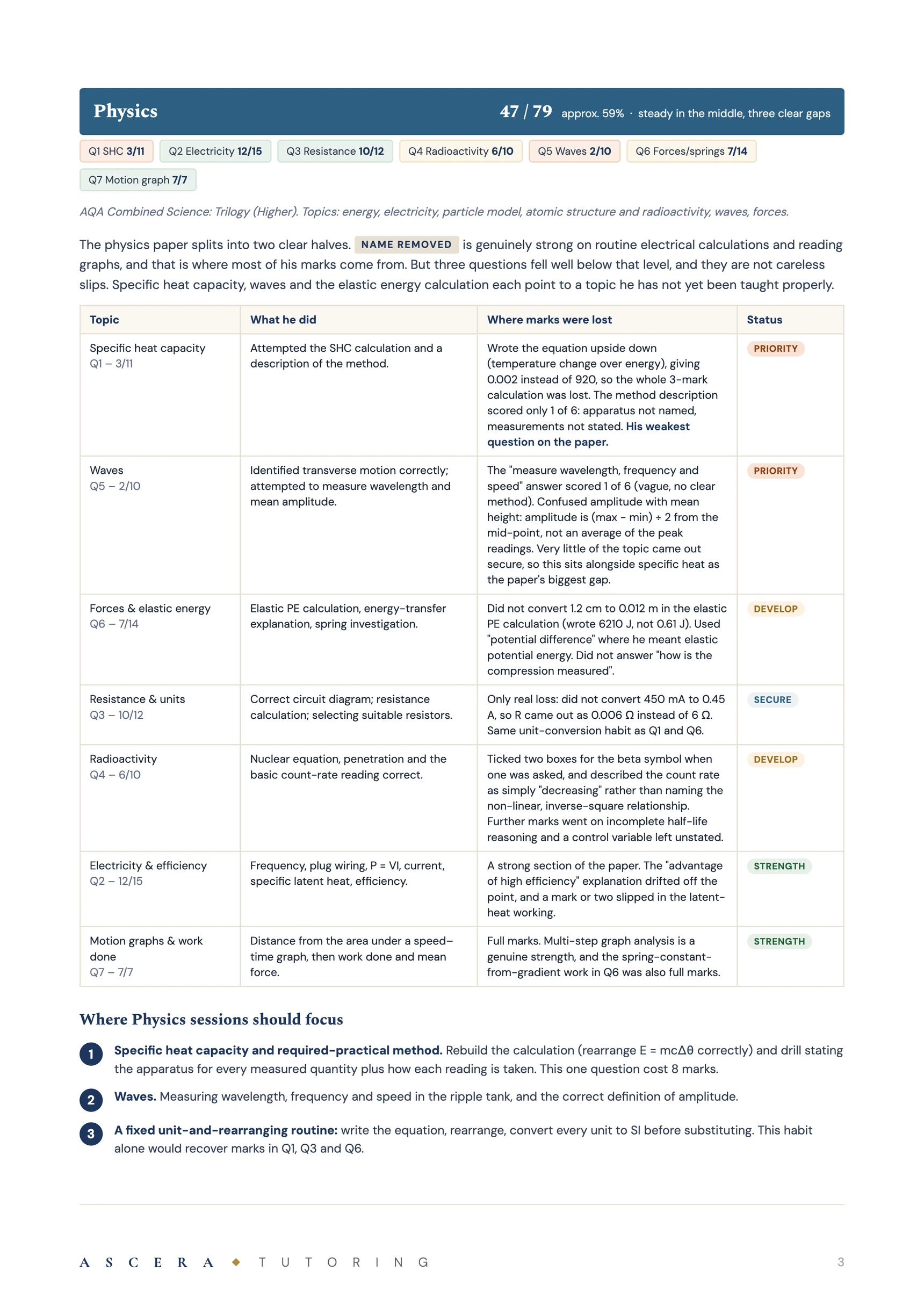
The core of the Diagnostic Report is a table covering every topic the paper sampled. For each one you see what your child actually did, precisely where the marks went, and a status telling you how much attention it needs. Nothing is described in general terms: every judgement is tied to a specific question on their own paper.
Priority a real gap costing marks now, and blocking other topics
Develop partly there, losing marks to specific errors not gaps
Secure solid, with one habit still costing the odd mark
Strength genuinely strong, not worth spending revision time on
Anonymised example GCSE Combined Science Diagnostic AQA Combined Science (Higher Tier) · Physics section
47 / 79approx. 59 per cent
The Physics page of a real Ascera Diagnostic Report, with the student's name removed. It shows the paper score of 47 out of 79, a mark chip for every question, and a table giving each topic, what the student did, exactly where the marks were lost and a status of priority, develop, secure or strength, followed by the three things Physics sessions should focus on. Open the full page
Read this page as text
Topic What they did Where the marks went Status
Specific heat capacityQ1, 3 of 11 Attempted the calculation and a written description of the method. Wrote the equation upside down, temperature change over energy, giving 0.002 instead of 920, so the whole 3-mark calculation was lost. The method description scored 1 of 6: apparatus not named, measurements not stated. Priority
WavesQ5, 2 of 10 Identified transverse motion correctly and attempted to measure wavelength and amplitude. The "measure wavelength, frequency and speed" answer scored 1 of 6, with no clear method. Confused amplitude with mean height: amplitude is measured from the mid-point, not averaged across the peak readings. Priority
Forces and elastic energyQ6, 7 of 14 Elastic potential energy calculation, energy-transfer explanation and the spring investigation. Did not convert 1.2 cm to 0.012 m, so the answer came out as 6210 J instead of 0.61 J. Used "potential difference" where they meant elastic potential energy. Did not answer how the compression is measured. Develop
Resistance and unitsQ3, 10 of 12 Correct circuit diagram, correct resistance calculation, suitable resistors selected. One loss only: 450 mA was not converted to 0.45 A, so the resistance came out as 0.006 ohms instead of 6. The same unit habit as Q1 and Q6. Secure
Motion graphs and work doneQ7, 7 of 7 Distance from the area under a speed-time graph, then work done and mean force. Nothing lost. Full marks, and the spring-constant-from-gradient work in Q6 was also full marks. Multi-step graph analysis is a genuine strength and does not need revision time. Strength

And the habit sitting underneath three of those rows

Maths under pressure: rearranging equations and converting units. This is the single most expensive habit on the paper. The specific heat equation was written upside down, 450 mA was not converted to 0.45 A, and 1.2 cm was not converted to 0.012 m. The same pattern then shows up in Chemistry mole ratios and Biology rate calculations, so it is one fix that recovers marks across all three papers rather than three separate ones.

This is a page from a Diagnostic Report exactly as it was sent to a family, with the student's name removed and nothing else altered. The full report covers all three sciences to this depth, and is followed by the Focus and Session Plan setting out the order to tackle it in.

How it works: four steps, about a week end to end

Nothing is posted and nothing needs to be arranged around a tutor's calendar. The paper is sat at home at a time that suits, and apart from one short call at the start, everything happens by email.

01
15 min

A short call first

We confirm the exam board, tier and year group, and check a diagnostic is actually the right thing. If your child has just started the course and there is very little to assess yet, we will say so rather than take the booking.

02
60–90 min

They sit the paper

We send the paper we have written for their board and tier. Sat at home under timed conditions, in one sitting, closed book, sampling the full specification rather than recent topics. Completed papers are photographed or scanned and sent back, so nothing needs posting.

03
5 working days

We mark it by hand

Marked against the board's own mark scheme conventions, with every dropped mark categorised: a knowledge gap, a method error, or a technique loss. That categorisation is what makes the report specific rather than descriptive.

04
By email

Report, plan and a recommendation

Both documents arrive together, yours to read in your own time. The recommended route is set out in writing alongside them, and any questions you have afterwards are answered in full. There is no obligation to book anything, and no follow-up sales call.

What each subject includes, and what it costs

Each subject gets its own paper, its own marking and its own written report. The Focus and Session Plan then covers the student rather than the subject: everything assessed is sequenced into one order of work, so the priorities are ranked against each other instead of arriving as separate lists. Subjects assessed at the same time are charged at the rates below.

Subjects assessedOne-off fee
One subject£50
Two subjects£80
Three subjects£110
Each additional subject+£30

Free with tutoring, for the subjects we tutor. If you book lessons, the diagnostic is not charged for those subjects. A family taking Biology lessons who also wants a Chemistry diagnostic pays the £30 additional-subject rate for Chemistry. There is no cap on the number of subjects, and there are no credits or bundles to keep track of.
The Ascera Programme

Everything the diagnostic found, acted on every month

The diagnostic says what to fix and in what order. The Programme is what acts on it: that plan turned into a schedule, four sheets a month aimed at those gaps, and the third of them timed and marked by hand so the plan keeps up with the student. Some students do not need a tutor. They need that structure, and this is everything a tutored student receives apart from the live lesson.

Starting from
£79
Per month, first subject
£35 each additional subject
Rolling monthly, cancel any time

What arrives each month

A personalised study schedule

Built at the start from the gaps the diagnostic found, and rebuilt each month as those gaps close and new ones surface. It says what to work on, in what order, and roughly how long it should take.

A homework sheet every week

Four a month, each aimed at a specific gap rather than at the topic in general, written to the student's own exam board and tier. The first, second and fourth come with a full answer key to mark as they go. The third is the assessed one, and it comes to us instead.

Work marked by hand, not by answer key

This is the core of the Programme. The third sheet each month has no answer key: it is sat under timed conditions, set on the gaps that month has been working on, and sent to us. It comes back marked against the board's mark scheme conventions, with written feedback on what was credited, what was not, and why.

A written progress report to you

Once a month, in plain English: what has moved, what has not, and what the next month is aimed at. Written from the marking, so it describes your child rather than a generic student at that grade.

Questions answered with the marking

Your child can send written questions in alongside that month's work and they are answered in the feedback. It is bounded to the monthly cycle deliberately, so the response is a proper worked explanation rather than a rushed reply.

It runs through the holidays

Most revision happens in July and August, which is exactly when structure is hardest to keep and easiest to lose. The schedule, the sheets and the marking carry on through every holiday at the same monthly rhythm, so the plan does not restart in September from wherever it was abandoned in July.

The monthly rhythm

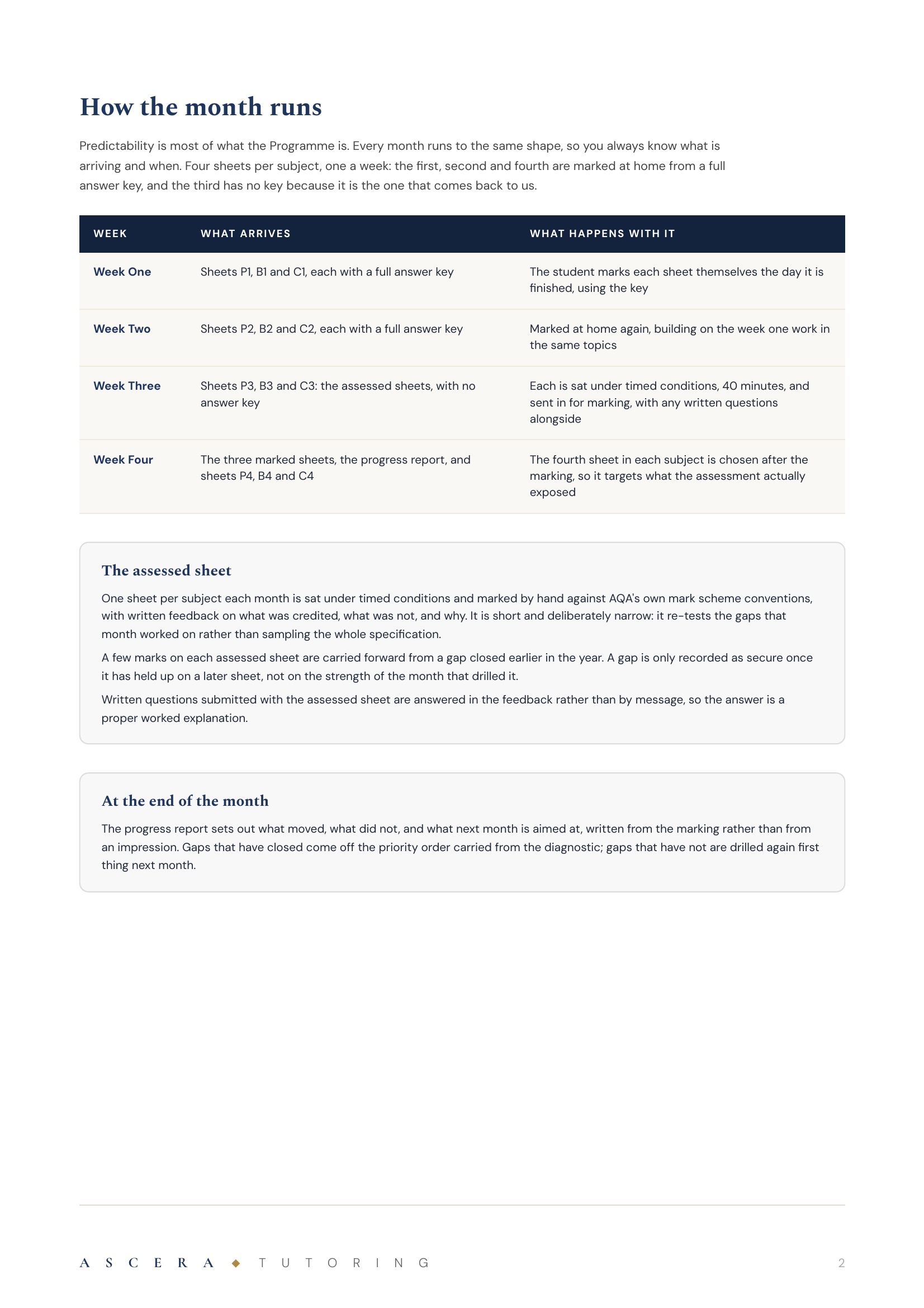
Predictability is most of what you are paying for. Every month runs to the same shape, so you always know what is arriving and when.

01
Week one

The month's plan goes live

The schedule is rebuilt around where your child actually is, and the first homework sheet arrives with its answer key.

02
Week two

Second sheet

Another targeted sheet, following the priority order set out in the focus plan rather than the order the school happens to be teaching in.

03
Week three

The assessed sheet

Sheets one and two were self-marked from their answer keys. The third has none: your child sits it under timed conditions and sends it in, with any written questions they want answered alongside it.

04
Week four

Marked work and your report

The marked sheet comes back with written feedback, your progress report follows, and the fourth sheet arrives, aimed at whatever the marking exposed. The gaps that month targeted are re-rated against the diagnostic: the ones that have closed come off the priority order, the ones that have not are drilled again in the next month's schedule.

What one month of the plan actually looks like

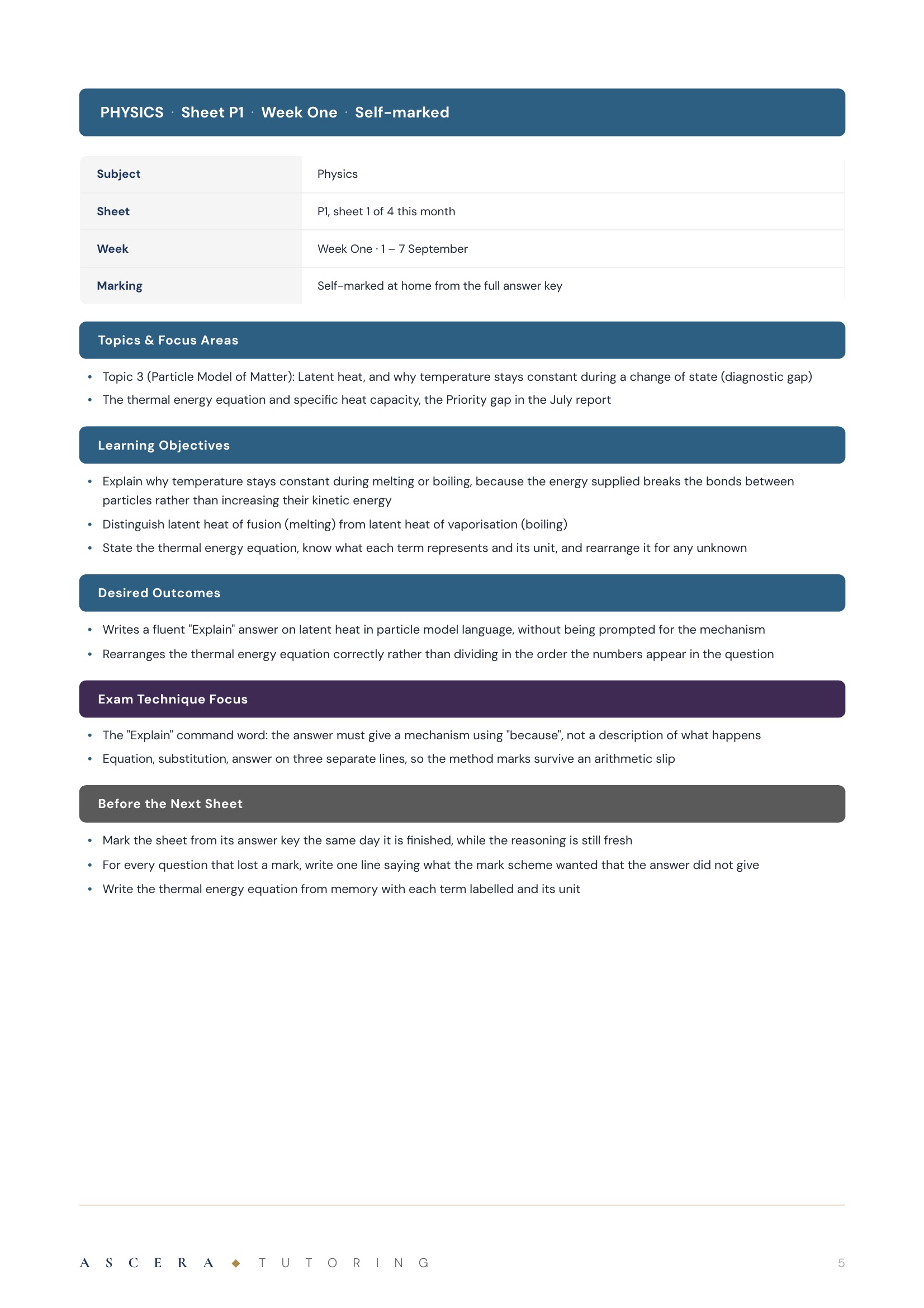
Two pages from a real Programme month, with the student's name and every other identifying detail removed. The first is the page the month opens with, so a parent can see what arrives and when. The second is a single sheet entry: what it targets, what your child should be able to do by the end of it, the exam technique drilled alongside it, and what to do before the next sheet.

Anonymised example The month at a glance AQA GCSE Physics · Biology · Chemistry

Why the month is shaped this way

Three of the four sheets in each subject are marked at home from a full answer key, so the feedback lands the same day the work is done. The third comes back to us instead, because a key cannot judge method, wording or whether an answer would have been credited. What every sheet targets is set by the priority order in the diagnostic, not by what school happens to be teaching that fortnight.

Switch between the two pages using the buttons above. Both are from a real Programme month, with the student's name, dates and every other identifying detail removed. A full month runs to one page per sheet across every subject, plus the pages listing what is not being targeted yet and why.

What the Programme is not

Being clear about the limits matters more than listing the features. A service like this goes wrong for both sides when the scope is left vague, so here it is stated plainly.

There is no live teaching No lessons, and no video calls beyond the initial consultation. If your child needs someone explaining it in real time, tutoring is the right product and we will tell you so rather than sell you this one.
There is no on-demand question line No WhatsApp or messaging access for ad-hoc questions. Written questions are submitted with that month's assessed sheet and answered properly in the feedback, which is worth more than a quick reply at ten at night.
It does not replace school The Programme targets the gaps your child is carrying. It is not a taught course and it does not deliver the specification from scratch.
It is not available without a diagnostic The whole product is defined by the gaps the diagnostic found. Sold without one it would be a generic worksheet subscription, which is not what this is.
It is not a full mock paper every month The assessed sheet is short and deliberately narrow: it re-tests the gaps that month worked on rather than sampling the whole specification, which is what lets it be marked properly and turned round inside the week. Full papers across the spec are what the diagnostic and the school's own mocks are for.

What each subject includes every month, and what it costs

A second subject brings a second set of everything that is subject-specific: its own sheets, its own assessed sheet marked by hand, its own gaps tracked. What does not repeat is the student. One schedule sequences every subject into a single order of work, and one progress report covers all of them, so the priorities are ranked against each other rather than arriving as separate lists.

Subjects coveredPer month
One subject£79
Two subjects£114
Three subjects£149
Each additional subject+£35

Rolling monthly. No minimum term, and one week's notice to cancel. A diagnostic is required first, and the Programme is included at no charge for any subject we tutor.

Tutoring

Everything in the Programme, plus the lesson that drives it

Everything in the Programme comes with it, and the lesson is what the rest is built around. A plan can tell a student what to fix and set work that targets it. It cannot watch them do it, and it cannot hear the sentence that shows the misunderstanding. The hour is where that changes: online, one to one or in a small group, taught to your child's exact board and tier, running to the same four-part structure every week so nothing is improvised. What the hour exposes then rewrites the plan, instead of the plan repeating what the diagnostic said months ago.

Quoted on your free call
01

The first session starts from the report

Not from a getting-to-know-you hour. The diagnostic has already established the board, the gaps and the order they need fixing in, so the first lesson goes straight at the highest-priority gap.

02

A written update after every session

What was covered, what was set, what is next, and what you might reinforce at home. Four a month, plus a consolidated monthly summary on top. You are never guessing what happens in the lesson.

03

The structure keeps running underneath

The schedule, the weekly sheets, the marking and the monthly report all continue around the lessons, and for every subject we tutor the diagnostic and the Programme are not charged for. What changes is where the work comes from: homework is set from what the lesson exposed rather than from the diagnostic baseline, and the schedule is revised continuously rather than once a month.

04

Taught to their board, not to the subject

AQA, Edexcel, OCR and OCR MEI examine the same content differently, and the difference is where marks are won at the top of the grade. Sessions are taught to the exact specification and tier, with mark-scheme language built into the teaching rather than added at the end as exam technique.

What happens inside a session

Every lesson follows the same four-part structure. The consistency is deliberate: your child knows what is coming, arrives prepared, and never spends the first ten minutes working out what the hour is for. The shape is fixed; what goes inside it is not. The topic taught in part two and the questions sat in part three are chosen for this student from their own plan, which is why two students on the same board in the same week get different lessons. The structure below is the standard one-hour block. A two-hour session does not run it twice: retrieval opens the session once, the teaching block stretches, and the practice and the review follow as they do here.

01
10 min

Retrieval on last time

A short recall check on the previous session and the work set between them. This is not admin: retrieval practice is how long-term memory is built. Anything that comes back shaky is noted and folded into the hour.

02
25 min

The topic the plan named

Taught in depth, with worked examples and the exact terminology the mark scheme rewards. Which topic that is was decided by the diagnostic and the plan, not by what came up at school that week. Your child is questioned throughout rather than listening.

03
20 min

Exam-style practice, unprompted

Real past-paper questions under timed conditions, attempted independently with no hints. This is where understanding meets exam pressure, and it is the part of the hour that changes marks.

04
5 min

Marked, and the next focus set

The questions from part three are gone through together, against the real mark scheme, so your child sees how each mark is earned rather than only what the answer should have been. Every dropped mark is named as a knowledge gap, a method error or a technique loss, and that decides what the next session covers. The written update reaches you the same evening, and the week's work is set with it.

Formats, and what is offered at each level

One-to-one runs at every level. Small group runs at 11+ and GCSE, where students can genuinely be matched by board and stage. It is not offered at A-Level: the specifications diverge too far between students for a group to serve any of them properly.

One-to-one, online

Available at every level: 11+, GCSE Maths, Biology, Chemistry and Physics, and A-Level Maths, Biology and Chemistry. The whole session is built round one student, so the pace follows what they actually need rather than an average.

Small group, 11+ and GCSE

Places are matched by level, board and stage, so everyone in the room is sitting the same paper and is at the same point in it. That matching is what makes availability vary through the year, and it is why the format is not offered at A-Level. Students see how other people answer the same question, which is worth more at 11+ and GCSE than it sounds.

Term booking

Twelve sessions booked as a block, on either format. It holds the same slot for the whole term even when the calendar is full, which is what keeps a programme running to its plan rather than around whatever time is left. It also fixes your rate for the whole term, so a change part-way through does not reach you mid-programme.

LevelOne-to-oneSmall group
11+ (GL, CEM and independent formats)AvailableAvailable
GCSE Maths, Biology, Chemistry, PhysicsAvailableAvailable
A-Level Maths, Biology, ChemistryAvailableNot offered

Side by side

What each one actually includes

Each service contains the one before it. Tutoring is not the Programme with lessons bolted on top: three of the components arrive in a better form, because a live lesson changes what the homework and the reporting can do.

What you get Diagnostic only Programme Tutoring
Diagnostic report and focus plan Included Required first Free
Findings explained and questions answered In writing, once In writing, every month In the lesson, then in writing
Personalised study schedule No Rebuilt monthly Revised continuously
Gap-targeted homework No Four a month, three self-marked from answer keys Weekly, set from what the lesson exposed
Work marked with written feedback No The third sheet, timed, each month Marked in the lesson, every sessionA full diagnostic at the start of every term
Progress reporting to you The report itself Monthly written report After every session, plus monthly
Live teaching No No Weekly, online
Runs through the school holidays Not applicable Continuously Lessons and Programme both
Price £50 one-off, +£30 per extra subject £79 a month, +£35 per extra subject Quoted on your free call

Families move between these. A tutored student whose lessons end can step down to the Programme rather than stop altogether, and a Programme student who plateaus can add lessons, at which point the Programme stops being charged for.

Results

What families say about the structure

Reviews left by Ascera families. The theme that comes up most often is not the teaching itself, it is knowing what is being worked on and why.

★★★★★

"Harsil is an excellent tutor who individually tailors every session to the student. He covered all the Higher level content with me in 4 months and I got the grades I needed for my university place."

Adult learner, returning to education · Summer 2025
GCSE Maths · Grade 6 → 8
★★★★★

"Just to let you know, my daughter ended up getting 9s in Biology and Chemistry. She worked incredibly hard, but your support definitely played a big part in that. The sessions were always focused and she always knew exactly what to work on between them."

Parent of Year 11 student · Summer 2025
GCSE Biology & Chemistry · Grade 9, 9
★★★★★

"We were a bit worried before starting as Physics had always been a weak point, but after a few weeks we could already see a difference. He's much more comfortable with the topics and not as anxious going into exams. The written updates after every session were really reassuring too, we always knew what was happening."

Parent of Year 11 student · Summer 2025
GCSE Physics · Grade 4 → 7
★★★★★

"Thank you for being so patient with her. You took the time to really understand where she was struggling and worked through it step by step. Her confidence has grown a lot, and the grades have followed."

Parent of Year 10 student · Spring 2025
GCSE Sciences · Year 10

Common questions

The three services, answered

The consultation is a conversation. We discuss your child's exam board, current grade and target, and work out whether Ascera is the right fit. It costs nothing and carries no commitment. The diagnostic is an assessment: your child sits a timed paper, we mark it, and you receive a written report showing exactly which topics and sub-skills are costing marks. Put simply, the consultation tells you whether we can help. The diagnostic tells you what to fix.
No, and there is no follow-up sales call. The diagnostic is a standalone service and both documents are yours regardless of what you decide. Some families use the report to guide revision at home, some share it with a school tutor, and some take the Ascera Programme instead of lessons. If the honest recommendation is that paid tutoring is not what your child needs right now, the focus plan will say so.
GCSE Maths, Biology, Chemistry and Physics, and A-Level Maths, Biology and Chemistry, across AQA, Edexcel, OCR and OCR MEI. 11+ is also covered, for GL Assessment, CEM and independent school formats. We write our own diagnostic paper for each board and tier rather than handing out a generic one, because the boards examine the same content differently and a paper written for the wrong board tells you very little.
The Programme is everything a tutored student receives except the live lesson: the study schedule, four gap-targeted homework sheets a month with the first, second and fourth self-marked from their answer keys and the third sat under timed conditions and marked by hand with written feedback, and a monthly written progress report to you. What it does not have is anyone sitting with your child explaining the material in real time. For a student who will work independently and mainly needs direction and honest marking, that is often enough. For a student who is genuinely stuck on the content, it is not, and we will say so.
Too early is possible. If your child is a term into a two-year course, there is not yet enough content to sample meaningfully, and we will tell you that on the call rather than take the booking. Too late is rarer than parents expect. After a disappointing mock is one of the most useful moments for a diagnostic, because the pattern behind the result is still fresh and there is time to act on it.

Start with the same first step

Whichever route you end up taking, it begins with a free 30-minute call. We confirm the exam board, check a diagnostic is genuinely the right next step, and arrange the paper if it is. No obligation, and no follow-up sales call.

1

Confirm the details

Exam board, tier, year group and the subjects you want assessed. We check a diagnostic is genuinely the right step.

2

Sit the paper at home

Sat under timed conditions at a time that suits, and sent back as photographs or a scan. Nothing needs posting.

3

Report, then choose your route

Both documents within five working days, setting out the findings and which of the three services actually fits. Any questions afterwards are answered in writing.

Book free consultation